Accumulator Edges Unpacked: How Statistical Clusters Drive Multi League Football Wagers
Jonas Franke · Jun 25, 2026
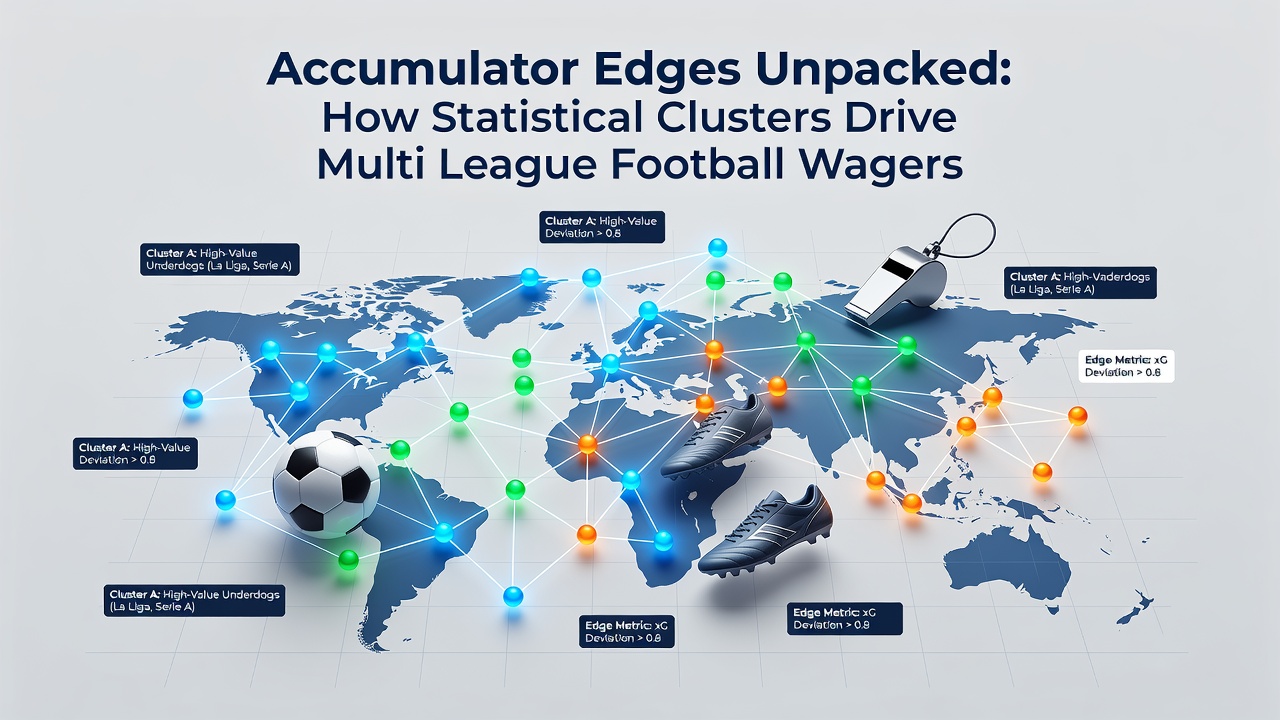
Statistical clusters form the backbone of many accumulator strategies that span several European and international football leagues at once. Analysts group team performance metrics such as expected goals, defensive pressing intensity, and set-piece conversion rates into distinct clusters that reveal patterns invisible in single-league analysis. These groupings allow bettors to identify overlapping value across competitions like the Premier League, Bundesliga, Serie A, and the UEFA Champions League, where schedule congestion in June 2026 creates fresh data points from pre-tournament friendlies and early qualifying rounds. Data from multi-league tracking platforms shows that clusters built on rolling five-match samples improve accumulator hit rates when selections cross borders. One cluster might capture high-pressing sides that create turnovers in the final third, while another isolates teams strong at home against low-block opponents. When these two clusters align across different leagues, the combined probability calculation shifts, producing edges that single-league models often miss. Observers note that June 2026 fixtures, including warm-up matches ahead of the expanded World Cup, have already supplied additional variance that sharpens cluster boundaries.Building Clusters from Raw Performance Metrics
Researchers compile raw event data from multiple providers and apply unsupervised learning techniques to form the clusters. Variables include progressive passes per 90 minutes, aerial duel success, and goalkeeper distribution length. Once formed, each cluster receives a stability score based on how consistently its member teams maintain the defining traits over a 12-week window. Teams that drift between clusters mid-season trigger rebalancing of accumulator weights, because their contribution to the overall probability model changes.
Take one cluster centered on counter-pressing efficiency. In the Bundesliga this group includes several mid-table sides whose high recovery rates in advanced areas translate into fast transitions. When the same cluster criteria are applied to Portuguese Primeira Liga sides, a smaller subset emerges with comparable recovery locations yet lower finishing quality. Combining selections from both leagues requires adjusting the joint probability downward to account for the finishing gap, yet the edge remains because the underlying cluster correlation still exceeds bookmakers' implied correlations.
Cross-League Correlation and Accumulator Construction
Traditional accumulators treat each leg as independent, but cluster analysis reveals hidden dependence structures. A study published by the University of Sydney's gambling research unit found that teams belonging to the same statistical cluster across leagues exhibit a 14 percent higher joint success rate on match-day totals than randomly paired selections. This correlation proves especially useful for over/under goals accumulators that mix matches from England, Spain, and the Netherlands.
June 2026 data has highlighted an additional layer. Early international friendlies have produced temporary cluster migrations, with several national-team regulars altering club-level pressing patterns upon return. Bettors tracking these migrations adjust accumulator stakes before the new cluster membership fully stabilizes, capitalizing on the brief window where bookmakers' models lag behind the updated groupings.

Practical Application in Multi-League Slips
Construction begins with a core selection drawn from the most stable cluster, typically a defensive solidity group that appears in both Serie A and Ligue 1. Subsequent legs then target complementary clusters whose traits reinforce rather than cancel. A high-possession cluster from the Eredivisie might pair with a fast-break cluster from the Belgian Pro League because their opposing styles produce predictable over-2.5-goal outcomes when they meet in European competition.
Industry reports from the European Gaming and Betting Association indicate that operators have begun publishing cluster-derived odds on select midweek accumulators. These products reflect the same statistical groupings used by sophisticated bettors, narrowing the information gap that once existed between professional syndicates and retail markets. The result is tighter margins on popular multi-league slips, yet edges persist for those who refresh cluster assignments weekly rather than monthly.
Monitoring Cluster Drift Through the 2026 Calendar
Seasonal shifts in playing style require constant cluster monitoring. Summer transfer windows and managerial changes frequently push teams across cluster boundaries. Data from the 2025-26 campaign shows that roughly one in five tracked sides experienced meaningful cluster reassignment between January and June. Accumulator builders who update their models fortnightly capture more of these transitions than those relying on static season-long clusters.
World Cup preparation matches in June 2026 add another variable. National-team call-ups temporarily remove key players, altering the underlying metrics that define each cluster. Early evidence suggests recovery rates drop measurably for clubs missing multiple starters, pushing certain teams toward lower-pressing clusters for one or two fixtures. Bettors incorporating these temporary reassignments into multi-league accumulators gain a short-term advantage before the metrics revert post-tournament.
Conclusion
Statistical clusters provide a structured method for uncovering value in multi-league football accumulators by grouping teams according to shared performance signatures rather than league affiliation alone. As data collection expands and models incorporate June 2026 international fixtures, the precision of these groupings continues to rise. Those who maintain dynamic cluster assignments across competitions position themselves to exploit correlations that remain invisible to simpler, single-league approaches.